
Scroll down for:
i. books
ii. articles (scroll down or: all, lockean libertarian, Kantian, feminist, sex and love).
iii. review essays, introductory pieces, commentaries
iv. encyclopedia entries
v. public philosophy
vi. reviews
i. books
Sex, Love and Gender
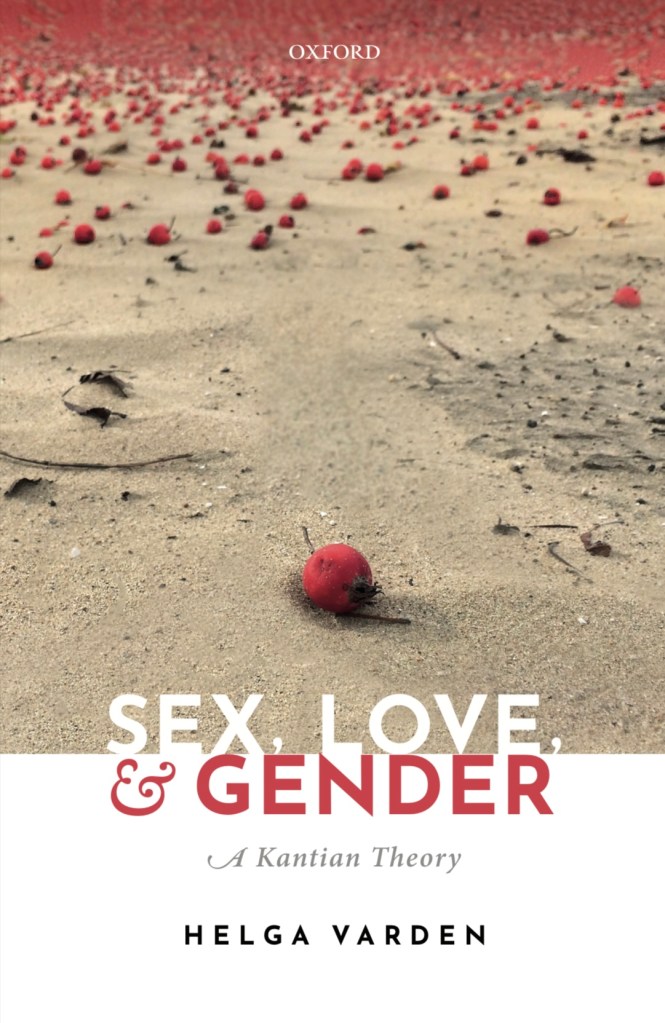
* Winner of the 2023 North American Kant Society Senior Scholar Prize *
Sex, Love, and Gender: A Kantian Theory is the first volume to present a comprehensive philosophical theory that brings together all of Kant’s practical philosophy — found across his works on ethics, justice, anthropology, history, and religion — and provide a critique of emotionally healthy and morally permissible sexual, loving, gendered being. By rethinking Kant’s work on human nature and making space for sex, love, and gender within his moral accounts of freedom, the book shows how, despite his austere and even anti-sex, cisist, sexist, and heterosexist reputation, Kant’s writings on happiness and virtue (Part I) and right (Part II) in fact yield fertile philosophical ground on which we can explore specific contemporary issues such as abortion, sexual orientation, sexual or gendered identity, marriage, trade in sexual services, and sex- or gender-based oppression. Indeed, Kant’s philosophy provides us with resources to appreciate and value the diversity of human ways of loving and the existential importance of our embodied, social selves. Structured on a thematic basis, with introductions to assist those new to Kant’s philosophy, this book will be a valuable resource for anyone who cares about these issues and wants to make sense of them.
Alternatively: Sex, Love, and Gender identifies a set of possibilities that define human beings’ sexuality. These sets come with their own concepts, which specify how the possibilities are realized and what effects they have on our lives lived together. Partly the task is descriptive. The description has to be plausible. Plausibility comes from the phenomenology (and not the other way around). Partly the task is normative. The normative content also has to be plausible. Plausibility here comes from vindicating the principles that underwrite the possibilities that define human beings’ sexualities and sexual experiences and behaviors lived by human beings and from the philosophical explanations and conclusions that follow. Overall plausibility, then, comes from discursive analysis of alternatives, from a priori argument, and, in the evaluative case, from showing how the Kantian account of a good life fits with reasonable conceptions of goodness consistent with the phenomenology of human lives. Although this exploration leads us, as we will see, to most corners of Kant’s practical philosophy, including his metaethics and metaphysics, the main focus is on an account of human sex, love, and gender explored explicitly with respect to happiness and ethics (virtue) and justice (right). It is because of this focus that the book is divided into two parts: Part 1 (“Human Sexuality and Virtue”) and Part 2 (“Human Sexuality and Right”).
reviews:
- Charlotte Sabourin for Kantian Review, Vol. 26(1):176-181.
- Janelle DeWitt, Carol Hay, and Jennifer Lockhart for SGIR Review, 2021, Vol. 4(1-2): 46-100.
- Melissa Seymour Fahmy for Mind, 2021 (fzab066)
- Evangelina Papadeki for Contextos Kantianos, No. 14, Dec. 2021
- J. A. Kegley for Choice Review, 2021 (59):3, review no. 59-0712.
- Macarena Marey for Studi Kantiani (forthcoming)
- Ann Cahill, Alice MacLachlan, and Jordan Pascoe for Estudos Kantianos, No. 11(1). 2023.
Essays on Kant’s Ethics and Political Philosophy

This essay collection is coming out November 2023 with Naghd-e Farhang Publications. Translator: Ali Pirhayati. Cover image: pluspointsphere.
List of Contents (in English):
1. “On a supposed right to lie from philanthropy” (Kant Lexicon)
2. Kant and Lying to the Murderer at the Door . . . One More Time: Kant’s Legal Philosophy and Lies to Murderers and Nazis
3. Kant and Dependency Relations
4. A Kantian Conception of Global Justice
5. Kant’s Non-Voluntarist Conception of Political Obligations
6. Kant’s Non-Absolutist Conception of Political Legitimacy
7. Kant and Arendt on Barbaric and Totalitarian Evil
8. Kantian Care
9. Kant and Moral Responsibility for Animals
ii. articles
- (forthcoming). “Kant and Political Obligations.” The Oxford Handbook of Political Obligation, edited by Georg Klosko.
- (forthcoming). “Nozick’s Kantian Roots.” In Nozick’s Anarchy, State and Utopia at 50, edited by Ralf Bader. Cambridge University Press. Cambridge Philosophical Anniversaries.
- (2024). “Toward a Karendtian Theory of Political Evil: Connecting Kant and Arendt on Political Wrongdoing.” Estudos Kantianos 12 (1): pp. 61-96.
- (2024). “Leaving the State of Nature: Strengths and Limits of Kant’s Transformation of the Social Contract Tradition.” ZPTh – Zeitschrift für Politische Theorie 15 (1): pp. 1-24.
- (2024). “A Kantian Theory of Intersectionality,” for Dignity, Freedom and Justice, ed. R. Gotoh, Springer, pp. 147-168.
- (2024). “Kant on Property,” for A. Gomes & A. Stephenson (eds.), Oxford Handbook on Kant, pp. 410-430.
- (2023). “Universality and Accommodating Differences: Religious, Racial, Sexual, Gendered,” in S. Baiasu and M. Timmons (eds.) The Kantian Mind, Routledge, ch. 32.
- (2022). “Kant and the Environment,” in Studi Kantiani, XXXV: 27-48.
- (2022). With Carol Hay. “On the Challenges of Good Sex and the Temptations of Bad Sex,” in D. Boonin (ed.) Sexual Ethics Handbook, Palgrave, pp. 73-92.
- (2022). “Kant’s Four Political Conditions: Barbarism, Anarchy, Despotism, and Republic.” Norsk Filosofisk Tidsskrift/Norwegian Journal of Philosophy, pp. 194-207.
- (2022). “A Kantian Account of Trauma.” for “Radicalizing Kant,” special edition of Kantian Review.Editors: Charles Mills and Corey W. Dyck, pp. 1-19.
- (2021). “Towards a Kantian Theory of Philosophical Education and Human Wisdom—with the help of Arendt,” for special ed. of Journal of the Philosophy of Education, eds. David Bakhurst and Martin Sticker, pp. 55(6): 1081–1096
- (2021). “Kant and Arendt on Barbaric and Totalitarian Evil,” Proceedings of the Aristotelian Society, Vol. cxxi (2): 221-248
- (2021). “Locke on Property,” in J. Gordon-Roth & S. Weinberg (eds.) 2021, The Lockean Mind, Routledge, pp. 428-437.
- (2020). “Kant and Privacy,” in A. Lyssy & C. Yeomans (eds.) Dimensions of Normativity: Kant on Morality, Legality and Humanity, Palgrave, pp. 229-252.
- (2020). “Kantian Care,” in Asha L. Bhandary & Amy Baehr (eds.) Caring for Liberalism: Dependency and Political Theory, Routledge, pp. 50-74.
- (2020). “Kant and Moral Responsibility for Animals,” in Kant & Animals, eds. Lucy Allais and John Callanan, Oxford: Oxford University Press, pp. 157-175.
- (2018). “Kant on Sex. Reconsidered: A Kantian Account of Sexuality: Sexual love, Sexual Identity, and Sexual Orientation,” Feminist Philosophy Quarterly 4(1): 1-33.
- (2018). “Kant’s moral theory and feminist ethics: women, embodiment, care relations, and systemic injustice,” in The Bloomsbury Companion to Analytic Feminism, ed. Pieranna Garavaso, Bloomsbury Academic, pp. 459-482.
- (2017). “Kant and Sexuality,” in The Palgrave Kant Handbook, ed. Matthew Altman, Palgrave Macmillan, pp. 331-353.
- (2017). “Kant and Women.” Pacific Philosophical Quarterly, Vol. 98(4): 653-694. (Electronic publication, Oct. 24, 2015.) DOI:10.1111/papq.12103
- (2016). “Self-Governance and Reform in Kant’s Liberal Republicanism: Ideal and Non-Ideal Theory in Kant’s Doctrine of Right,” special edition of dois pontos, ed. Daniel Peres, 13(2): 39-70.
- (2016). “Rawls vs. Nozick vs. Kant on Domestic Economic Justice,” in Kant and Social Policies, eds. Andrea Luisa Bucchile Faggion, Nuria Sánchez Madrid, Alessandro Pinzani, Palgrave Macmillan, pp. 93-123.
- (2014). “The Terrorist Attacks in Norway, July 22nd 2011— Some Kantian Reflections.” Norsk Filosofisk Tidsskrift/Norwegian Journal of Philosophy, Vol. 49(3-4): 236-59.
- (2012): “A Feminist, Kantian Conception of the Right to Bodily Integrity: The Cases of Abortion and Homosexuality.” In Out of the Shadows, eds. Sharon L. Crasnow & Anita M. Superson, New York: Oxford University Press, pp. 33-57. (Reprinted in The Right to Bodily Integrity, ed. A. M. Viens, in the series International Library of Essays on Rights, Ashgate, 2014, pp. 153-77.)
- (2012). “A Kantian Critique of the Care Tradition: Family Law and Systemic Justice.” Kantian Review, 17(2): 327-356.
- (2012). “The Lockean ‘Enough-and-as-Good’ Proviso – an Internal Critique.” Journal of Moral Philosophy (9): 410-22.
- (2011). “A Kantian Conception of Global Justice.” Review of International Studies, Vol. 37(5): 2043-2057.
- (2010). “Kant and Lying to the Murderer at the Door… One more Time: Kant’s Legal Philosophy and Lies to Murderers and Nazis.” The Journal of Social Philosophy, 41(4): 403-421.
- (2010). “Lockean Freedom and the Proviso’s Appeal to Scientific Knowledge.” Social Theory and Practice, Vol. 36(1): 1-20.
- (2010). “A Kantian Conception of Free Speech.” In Free Speech in a Diverse World, ed. Deirdre Golash, Springer Publishing, pp. 39-55.
- (2010). ”Kant’s Non-Absolutist Conception of Political Legitimacy: How Public Right ‘Concludes’ Private Right in ‘The Doctrine of Right’.”Kant-Studien, (3): 331-51.
- (2009). “Nozick’s Reply to the Anarchist: What He Said and What He Should Have Said About Procedural Rights.” Law and Philosophy, Vol. 28(6): 585-616.
- (2008). “Diversity and Unity. An Attempt at Drawing a Justifiable Line.” Archiv für Rechts- und Sozialphilosophie/Archives for Philosophy of Law and Social Philosophy (ARSP), Vol. 94 (1): 1-25.
- (2008). “International and Cosmopolitan Political Obligations.” In Coercion and the State, David A. Reidy and Walter Riker (eds.), Springer Publishing, pp. 239-250.
- (2008). “Kant’s Non-Voluntarist Conception of Political Obligations: Why Justice is Impossible in the State of Nature.” Kantian Review, Vol. 13(2): 1-45.
- (2007). “A Kantian Conception of Rightful Sexual Relations: Sex, (Gay) Marriage and Prostitution.” Social Philosophy Today, (22): 199-218.
- (2006). “Locke’s Waste Restriction and His Strong Voluntarism.” Locke Studies, (6): 127-141.
- (2006). “Kant and Dependency Relations: Kant on the State’s Right to Redistribute Resources to Protect the Rights of Dependents.” Dialogue – Canadian Philosophical Review, (XLV): 257-84.
- (2001). “Politisk filosofi uten metafysikk?” Norsk Filosofisk Tidsskrift, Nr. 3. (Translation: “Political Philosophy without Metaphysics?” Norwegian Journal of Philosophy, No.3.)
- (2000). “Dygd, lyst og lykke i Aristotles Nicomachean Ethics”. Kjellerdypet, Vol. 3-4. (Translation: “Virtue, Lust and Happiness in Aristotle’s Nicomachean Ethics”, Kjellerdypet.)
iii. review essays, introductory pieces, commentaries
- (2024). “Jordan Pascoe’s Kant’s Theory of Labour: A Kantian Engagement.” Kantian Review. Published online 2024:1-8. doi:10.1017/S1369415424000177
- (2022). “Asha Bhandary’s Freedom to Care–A Kantian Care Engagement.” Dialogue Canadian Philosophical Review, pp. 1-14. (doi:10.1017/S0012217322000154)
- (2015). “Immanuel Kant – frihetens politiske filosofi”/“Immanuel Kant – Justice as Freedom.” The Norwegian version (“Immanuel Kant – frihetens politiske filosofi”) appears in Politisk filosofi. Fra Platon til Hannah Arendt,ed. Jørgen Pedersen, Pax Forlag, pp. 472-98. (Norwegian anthology of essays on central figures in the history of political philosophy.) The English version (“Immanuel Kant – Justice as Freedom”) is published in Philosophie de la justice/Philosophy of Justice, Vol. 12 in the series Contemporary Philosophy, ed. Guttorm Fløistad, Dordrecht, the Netherlands: Springer, pp. 213-37.
- (2015). “John Locke – anarkistisk libertarianisme”/“John Locke – Libertarian Anarchism.” The Norwegian version appears in Politisk filosofi. Fra Platon til Hannah Arendt,ed. Jørgen Pedersen, Pax Forlag, pp. 370-93. (Norwegian anthology of essays on central figures in the history of political philosophy.) The English version (“John Locke – Libertarian Anarchism”) is published in Philosophie de la justice/Philosophy of Justice, Vol. 12 in the series Contemporary Philosophy, ed. Guttorm Fløistad, Springer: the Netherlands, pp. 157-76.
- (2014). “Patriotism, Poverty, and Global Justice—A Kantian Engagement with Pauline Kleingeld’s Kant and Cosmopolitanism,” Kantian Review, Vol. 10(2): 251-266.
- (2011). “Amartya Sen’s The Idea of Justice – Some Kantian Rejoinders.” Social Philosophy Today, Vol. 27: 217-32.
- (2011). “Coercion and the State.” A review of Sharon Byrd and Joachin Hruschka’s “Kant’s Doctrine of Right: A Commentary” Jurisprudence, Vol. 2(2): 547-559.
- (2010). (G. A. Cohen’s) “Rescuing Justice and Equality – A Critical Engagement.” Social Philosophy Today, Vol. 26: 175 – 189.
- (2009). Critical Commentary on Ann Cudd’s Analyzing Oppression, OUP 2006. Contribution to web-based symposium on the web forum Symposia on Gender, Race, and Philosophy (SGRP), Volume 5(1). Web forum organized by Bob Gooding-Williams (Northwestern), Sally Haslanger (MIT), Ishani Maitra (Rutgers), Ron Sundstrom (USF), and Cynthia Willett (Emory).
iv. encyclopedia entries
- (forthcoming). “Kantian Autonomy,” for Encyclopedia of the Philosophy of Law and Social Philosophy, eds. T. Sellers and S. Kirste, Springer.
- (2021). “On a Supposed Right to Lie from Philanthropy,” for The Cambridge Kant Lexicon, ed. Julian Wuerth, Cambridge: Cambridge University Press, pp. 691-695.
- (2015). “Robert Nozick,” in The Cambridge Rawls Lexicon, eds. J. Mandle and D. Reidy, Cambridge: Cambridge University Press, pp. 561-5.
- (2011). The following entries in the Encyclopedia of Global Justice, ed. Deen K. Chatterjee, Springer Netherlands: “Charity,” pp. 117-119; “Kant, Immanuel: Contemporary Kantian Responses to,” pp. 610-613; “Kant, Immanuel,” pp. 609-610; “Duties, Perfect and Imperfect,” pp. 280-81; “Duties, Positive and Negative,” pp. 281-284; “Nozick, Robert,” 760-762
v. public philosophy
- (2025). “Nick Cave, Dolly Parton, and Sojourner Truth Walk into a Bar…” Contextos-Kantianos 21: 1-3
- (2025). “Gender is Determined by Experience, not Biology or Choice.” In Institute for Arts & Ideas, April 16.
- (2024). “Rawls vs. Nozick: Justice or Freedom?” In Institute for Arts & Ideas. June 6. (Penultimate version here.)
- (2024).(2024). “A Conversation with Professor Helga Varden Traversing Philosophy, Sex, Love, and Social Contracts.” Interviewed by Daniela Andrade and Lucy Nicholls. MamaMuse April 19, 2024.
- (2023). “How to Move Beyond Our Endless Disagreements over Abortion Policies: A Kantian solution to what seems an insoluble moral conflict.” Public Seminar (11.08.2023).
- (2023). “A love letter across the ocean to Esben Esther Pirelli Benestad.” Blikk (03.28.2023).
- (2020). Podcast interview (“Immanuel Kant’s Racism and Sexism with Professors Lucy Allais and Helga Varden”) with Tanishq Khurana for The Philosophy Junkie. (10.31.2020).
- (2018). Podcast interview (“Kant’s Theory of Sexuality”) with Ole Morten Moen and Aksel Braanen Sterri on Moralistene/Moralizers (Norwegian only).
- (2016). “Retten til frihet–om fremmedgjøring og undertrykking i den norske offentligheten.” Salongen–Tidsskrift for filosofi og idehistorie. (11.15.2016) (Norwegian only.)
- (2016). “The Politics of Narcissism, Dehumanization, and Dispossession: From Norway to Orlando to Britain.” Medium (06.27.2016).
- (2016). “Niqab-forbud stenger folk ute.” (“Norwegian law against niqab excludes women from higher education”), with Hege Cathrine Finholt (U. of Oslo), Vårt Land. (10.08.2016) (Norwegian only.)
- (2016). “Norsk filosofi–en liten runde til.” (Norwegian Philosophy—Another Quick Round”) (06.01.2016). (Norwegian only.)
- (2015). “Den fattige debatten.” (”The lack of informed public debate in Norway”), in Salongen–Tidsskrift for filosofi og idehistorie. (11.25.2015) (Norwegian only.)
- (2015). “Norsk filosofi–et blikk utenfra” (Norwegian Philosophy—A View from the Outside”), in Salongen–Tidsskrift for filosofi og idehistorie.” (07.31.2015) (Norwegian only.)
vi. reviews
- (2023). “Barbara Herman’s The Moral Habitat.” Philosophical Review, 132(2): 313-316.
- (2017). Review of Sidney Axinn Sacrifice and Value: A Kantian Interpretation (Rowman & Littlefield, 2010), Critique. (2017.01.22.)
- (2014). Review of Martha C. Nussbaum’s Political Emotions: Why Love Matters for Justice, Harvard University Press, 2013 in Notre Dame Philosophical Reviews. (2014.03.34)
- (2013). Review of Carol Hay’s Kantianism, Liberalism, Feminism: Resisting Oppression, Palgrave, 2013, in Notre Dame Philosophical Reviews (2013.11.05).
- (2012). Review of Elisabeth Ellis’ (ed) Kant’s Political Theory: Interpretations and Applications, Penn State Press, in Notre Dame Philosophical Reviews (2013. 01.31).
- (2010). Review of Jan Narveson and James P. Sterba’s Are Liberty and Equality Compatible, Cambridge University Press, 2010, in Notre Dame Philosophical Reviews (2010.08.16).
- (2010). Review of Thomas E. Hill Jr.’s (ed) Blackwell Guide to Kant’s Ethics, Blackwell, 2009, in Ethics, Vol. 120(4): 860-864.
- (2008). Review essay of Otfried Höffe’s Kant’s Cosmopolitan Theory of Law and Peace, transl. by Alexandra Newton. Cambridge University Press, 2006, in Symposium: Canadian Journal of Continental Philosophy, Vol. 12(1): 168-174.
- (2007). Review of Paul Guyer’s Kant, New York: Routledge, 2006, in Notre Dame Philosophical Reviews (02.03. 2007).
- (2007). Review of Paul Saurette’s The Kantian Imperative: Humiliation, Common Sense, Politics, University of Toronto Press 2005, in “Letters in Canada”, the University of Toronto Quarterly, Vol. 76(1): 305-307.
 Helga Varden